
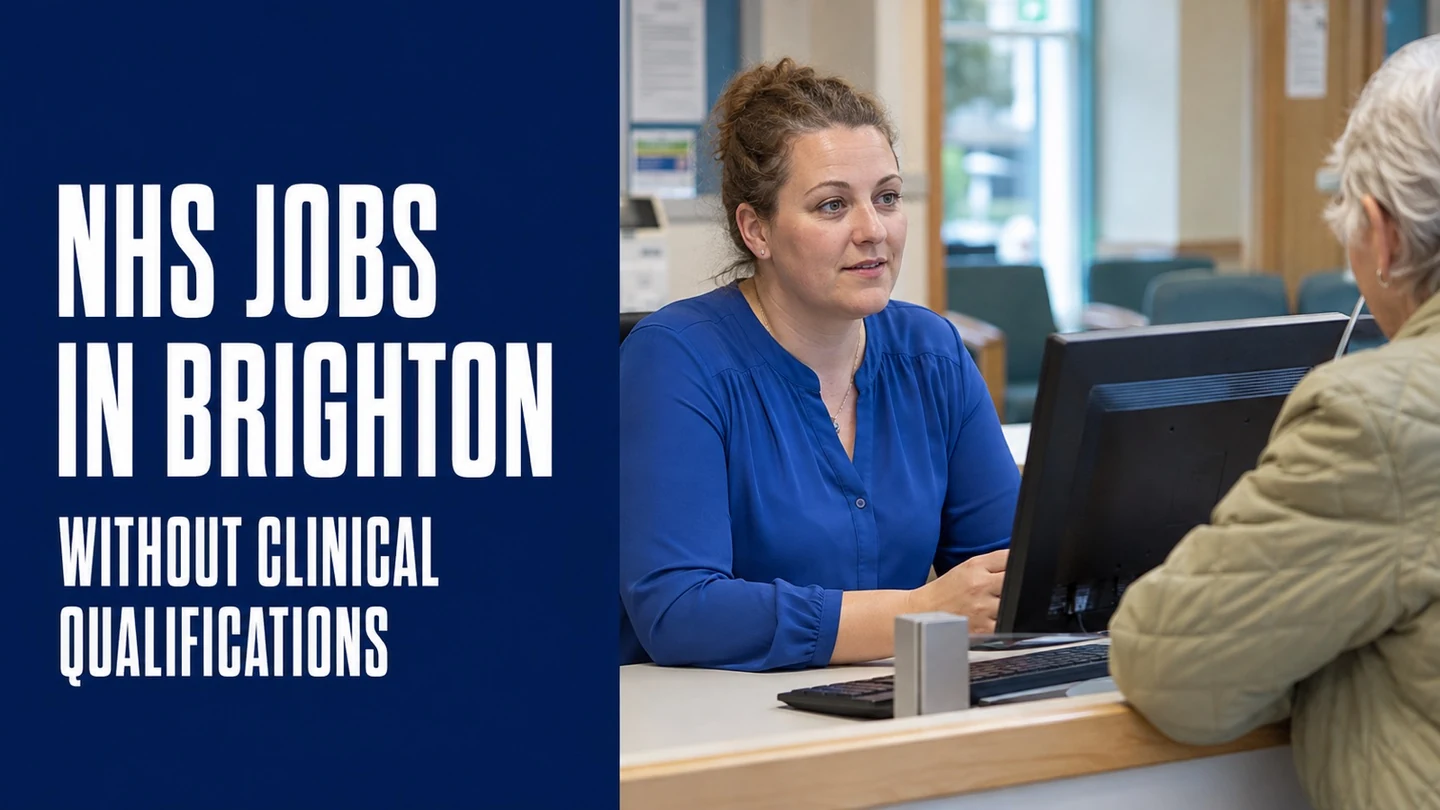
You do not need to be a nurse, doctor or therapist to work in the NHS. If you are looking for NHS jobs in Brighton without clinical qualifications, start with reception, administration, records, portering, cleaning and catering.
These are not all “no experience” jobs, and non-clinical does not necessarily mean working away from patients. This guide explains where to look, how to compare contracts and what evidence can help you get an interview.
Which non-clinical NHS jobs should you search for?
NHS Professionals' non-clinical careers guide lists administrative, facilities and corporate roles. Use specific titles rather than searching only for “NHS jobs”:
| Search terms | What to check before applying |
|---|---|
| Receptionist, ward clerk, appointments administrator | Patient contact, telephone work, computer skills and the exact shift pattern. |
| Health records clerk, administrative assistant | Accuracy, document handling, confidentiality and any required office experience. |
| Domestic assistant, cleaner, catering assistant | Cleaning or food-service duties, physical demands, training and early or late shifts. |
| Hospital porter | Patient and equipment movement, physical requirements and the rota. |
| Finance assistant, HR administrator, IT support | Relevant technical skills or qualifications; these are not automatically entry-level roles. |
Read the person specification, the document listing essential and desirable requirements. “NHS experience desirable” is different from “NHS experience essential”.
For example, a March 2026 Regency Surgery advert in Brighton, now closed, listed primary-care experience as desirable but customer-service experience, IT skills and confidentiality as essential. It illustrates an entry route, not a current vacancy. Read the original NHS Jobs specification.
For records work, the National Careers Service says employers may request English and maths GCSEs; office and customer-service experience can help. Do not buy a course before checking whether your target adverts actually require it.
Important distinction: healthcare assistant and clinical support worker posts can involve direct personal care. They are a different route from the non-clinical jobs covered here. Check the duties, not just whether a degree is required.
Where to find NHS jobs in Brighton and Hove
Start with Brighton PartTimer's NHS employer page, then check the original employer advert and its attachments. The hub is a useful starting point, but some listed roles require professional registration.
For hospital work, check University Hospitals Sussex vacancies. Its Brighton campus includes the Royal Sussex County Hospital, Royal Alexandra Children's Hospital and Sussex Eye Hospital, as described in its candidate information pack.
On NHS Jobs, search “Brighton” with one role title at a time. Look across University Hospitals Sussex, Sussex Community, Sussex Partnership and local GP employers. Try Hove separately and adjust the distance filter to your actual commuting limit.
Check these details before writing anything:
- Employer: a hospital trust, GP practice or contractor?
- Base: Brighton itself or a service elsewhere in Sussex?
- Eligibility: essential experience, qualifications and any sponsorship restrictions.
- Hours: the actual rota, not simply “part-time” or “flexible”.
NHS pay and benefits: what would you actually receive?
For jobs on England's Agenda for Change pay system, these are the 2026/27 basic full-time annual rates, effective from 1 April 2026:
| Pay band | Entry salary | Top of band |
|---|---|---|
| Band 2 | £25,272 | £25,272 |
| Band 3 | £25,760 | £27,476 |
| Band 4 | £28,392 | £31,157 |
Source: NHS Employers' 2026 pay table, hosted on Trac. The advert determines the band; a job title alone does not. Do not budget for the top rate unless your offer confirms it.
The standard Agenda for Change working week is 37.5 hours, according to NHS finance careers guidance. A 22.5-hour contract is 60% of full-time hours. At Band 2, that means £15,163.20 gross a year, or £1,263.60 gross a month, before deductions and any additional payments. That is an illustration, not a take-home estimate.
UHSussex's candidate pack describes annual leave starting at 27 days plus bank holidays, rising to 29 days after five years and 33 after ten, pro rata for part-time work. Its benefits page also lists the NHS Pension Scheme, flexible-working opportunities, staff discounts, development and wellbeing support.
Check the contract, not the NHS logo. GP and contractor terms can differ from trust contracts. For bank work, ask how holiday pay and pension membership work. If a rota includes nights or weekends, request the applicable pay rules rather than assuming every inconvenient shift attracts extra money.
Permanent, part-time, bank or hybrid: choose the right fit
A regular employed post: compare contracted weekly hours, whether the job is permanent or fixed-term, and whether working days are fixed or rotate. Part-time does not necessarily mean choosing your own days.
Staff bank: this covers staffing gaps rather than offering the same arrangement as a regular post. Sussex Partnership's bank guidance explicitly includes administrators and says recruited bank workers choose from available shifts. Ask about Brighton availability, minimum commitments and cancellations before relying on it for essential bills. Joining does not establish a guaranteed weekly income.
Hybrid administration: treat home working as a point to confirm, not a benefit attached to every admin title. Ask how much attendance is required during training and afterwards.
Apprenticeships: UHSussex offers pathways including finance and business, combining paid work with a qualification. Check the advertised pay, study commitments and entry criteria. This can suit a career change, but it is not simply casual work between lectures.
How to write an NHS supporting statement that earns its space
Sussex Partnership's recruitment guide explains that applicants are shortlisted against job requirements. A general paragraph about wanting to help people is not enough evidence on its own.
Try this method:
- Copy each essential criterion into your notes. Mark it “evidence ready”, “need a clearer example” or “do not currently meet”.
- Choose genuine examples. Retail complaints can demonstrate calm communication; booking systems can demonstrate accuracy; volunteering can demonstrate reliability.
- Explain your actions and outcome. Say what you personally did, not just what your team achieved.
- Address the actual service. Explain why accurate administration or reliable support matters to its patients.
- Check the submission format. Complete the requested fields and attachments rather than assuming a CV replaces the application form.
A useful writing scaffold is:
“In [real setting], I was responsible for [task]. When [problem arose], I [specific actions]. This resulted in [honest outcome] and demonstrates [criterion].”
Do not claim clinical judgement, systems knowledge or qualifications you lack. If a requirement says “or equivalent experience” and you are unsure what counts, ask the named recruiting contact.
AI can help identify unclear sentences or generate practice questions. Keep ownership of the examples and final wording; do not upload patient information or invent achievements. Our cover-letter and AI guide explains the distinction between editing your evidence and outsourcing your voice.
NHS interview questions: what should you prepare?
Sussex Partnership says interviews commonly involve two or more people, and invitations explain any additional tests. Read yours carefully and request any necessary adjustments through the recruiting team.
In an NHS admin interview discussion on Reddit, one contributor reported being asked about demonstrating trust values and handling conflict. Another described a confidentiality question about giving results to a friend. These are anonymous accounts, not a verified Brighton question bank.
Prepare short STAR examples: situation, task, action and result. At UHSussex, the published values are compassionate, inclusive and respectful. Use the values of your actual prospective employer, not another trust's.
These are our practice questions, not promised interview questions:
- “Why this role?” Connect your experience to the duties and explain why the service interests you.
- “Tell us about a difficult conversation.” Describe listening, explaining clearly and getting appropriate help.
- “A friend asks you to look up their results. What do you do?” Explain confidentiality, authorised access and directing them through the correct service.
- “Several tasks arrive together. How would you prioritise?” Explain how you would clarify urgency and seek guidance, without pretending to make clinical decisions.
- “You notice an error in a record or booking. What next?” Explain checking, reporting and following the correction process rather than concealing it.
Ask the panel: “What would good performance look like after three months, and who will train me?” For shift roles, also ask to understand a typical rota.
What staff experiences tell us about the job
Online accounts are useful for identifying questions, not predicting your future team.
In a Reddit discussion about a first Band 3 admin job, the author described extra workload and disagreement over when home working would begin. A respondent in the same thread said they:
“really enjoy my job and colleagues.”
That mix is more useful than declaring NHS admin universally wonderful or terrible. Neither account establishes conditions at a Brighton employer.
There are also development opportunities to investigate. On UHSussex's apprenticeship page, a finance apprentice describes contributing to a salary-sacrifice project and wanting to continue with further accounting study. It is an employer-selected story, not an independent review or a promise of promotion.
Turn those experiences into questions: Who sets priorities when work builds up? How long is supervised training? What flexibility will be confirmed in writing?
After an offer: do not assume you can start immediately
Sussex Partnership describes conditional offers followed by pre-employment checks, including references and any role-appropriate DBS checks. Its guidance also addresses identity and occupational-health clearance. Not every non-clinical role requires the same checks.
Confirm outstanding requirements and an agreed start date before making commitments based on a verbal offer.
Your next step is manageable: choose two suitable role titles, check the Brighton NHS jobs hub, and match one person specification against your real experience. A focused application is more useful than applying for every vacancy with “NHS” in the title.